VA Veterans Crisis Line ~ Dial 988 ~ Then Press 1
The Korean Conflict showed the afterburning Air Force zoomsters that there was still a strong need for Close Air Support (CAS). The young Air Force was totally into the jets that they thought were the answer to everything; the Army was miffed about what to do to help their infantry; the Navy was busy fending off the Air Force; and the Marines wanted CAS as bad as the Army but were forced to make do with what they had. In 1960, two Marine Aviators - K. P. Rice and W. H. Beckett put pencil to paper – usually napkins – and created what they thought was the ideal Short Landing and Take Off Counterinsurgency Light Armed Reconnaissance Aircraft. But nobody would build it for them so, they started building one in a garage.
They not only designed and built a mockup of the plane, but they developed a concept for what a Short Landing and Take Off Counterinsurgency Light Armed Reconnaissance Aircraft would do for the ‘boots-on-the-ground’ Grunts. When word got out about what they were building and what they hoped to do with it, the ‘System’ turned in on them. The design they came up with was definitely not “normal,” but they thought it would do tactically useful jobs that nothing else could do.
Their design was sound, their concept was solid, their perseverance was sincere and the need was severe. In the end the system didn’t give them what they wanted, but by demonstrating a prototype, it was the only way it might have been done.
Their time spent building the mockup was offset by writing the L2VMA Concept and even though the ‘System’ didn’t accept their Concept, it did lead to the LARA COIN competition and their balsa wood and fiberglass mockup turned into the North American Aviation OV-10 ‘Bronco'.
 The OV-10 Story In Memory Of W.H. BECKETT & K.P. RICE 1960 - THE NEED, CONCEPT OF OPERATION AND GENERAL SPECIFICATIONS MAJ W.H. BECKETT, MAG-15 Introduction L2VMA is/was the Navy acronymic way to say Marine Light Attack Aircraft. As published in Chapter Four of the DICTIONARY OF AMERICAN NAVAL AVIATION SQUADRONS shows: PREFACE Sixteen years ago the aircraft industry hit the "con trails." The atom was smashed, the sound barrier broken. The era of boom and zoom was launched in the middle of the mushroom clouds. The man in the Buck Rogers suit became the new hero of the new age. Thermonuclear annihilation "push button" style was as real a possibility as the miracle of the dial selector washing machine. But when the dark rain of fallout fell on an awestruck world, both sides of the international political question had grim second thoughts about resolving their differences by leaving a vacant spot in the solar system. The possibility of such a war remains with us. It must assuredly be prepared for! Meanwhile, back in the foxholes of Korea, the jungles of Indo-China and the sands of Israel and Jordan, war proceeds pretty much as usual. Not the blast of the atom bomb, but the burst of machine gun fire breaks the silence of this "twilight peace" we are enjoying. The rifleman is no anachronism. He is very much with us and in active service. Read the daily newspaper. The aviation complex, industrial and military, in its rightful pride and zeal, in being the instrument of the future and the vanguard for conquering space, has neglected the exigencies of current warfare and providing the requisite airborne support for same. INTRODUCTION Limited war is a current reality. The USMC is an ideal weapon in such a war. The following study is a consideration of the modern concept of limited war in terms of current aviation capabilities and weaknesses, both tactical and logistical, with special attention to the need for a new type of aircraft designed specifically to eliminate these weaknesses. Better air support than that which can be obtained with current high performance type aircraft is needed, especially for limited war situations. After studying the problem and determining in general the additional capabilities that are needed for adequate air support, various means of achieving these capabilities were examined. The most promising approach appeared to be a concept in which very light S.T.O.L. (short take off and landing) aircraft are used to supplement existing high performance types. Performance characteristics can be obtained with light aircraft which permit greatly increased effectiveness through tactical innovations. Further advantages can be obtained by developing applicable weapons and tactics simultaneously with the vehicle needed to implement them. Aircraft design and tactics are interdependent and both must conform to expected requirements and environmental considerations. The explanation of a light support concept and description of the aircraft characteristics necessary to implement it are therefore complicated by a certain amount of background material. The nature of war in which the Marine Corps might become involved in the next few years will be considered first. This will provide the background necessary to define current inadequacies in terms of probable combat environment. The advantages of meeting the resulting requirements through the use of a light attack vehicle will be compared with the possibility of replacing current aircraft with more complex and versatile types. Finally, specifications for a feasible light STOL support vehicle will be developed. Using the predicted performance of a sample vehicle, tactics for its employment will be described so that its effectiveness and viability can be evaluated. ENVIRONMENTAL CONSIDERATIONS 1. General. The maintenance of a strong deterrent is a prerequisite to national existence and cannot be neglected. On the other hand, the ability to react rapidly and effectively in a limited or cold war situation is the greatest immediate military problem facing the United States today. It has become obvious that limited or cold war operations are much more likely than an all out war. The Marine Corps, as a "force in readiness," and by the virtue of its composition and amphibious capability, is particularly concerned with the limited war problem. While it is impossible to predict how and under what conditions a limited war would be fought, certain aspects of environment which could become critical in future operations can be foreseen. 2. Political Sanctuaries. One of the most significant limited war factors from an aviation standpoint is that political sanctuaries are not only a possibility, but a probability. Without political sanctuaries somewhere, the war could not be limited. In a limited war between two major powers, sanctuary areas are almost certain to exist because any threat to an opponent's strategic striking force will invite a thermonuclear holocaust. Attack on less vital sanctuaries will almost certainly enlarge the area of conflict. In the Korean War the Chinese Communists operated from a sanctuary behind the Yalu River and United Nations forces at sea or in Japan were not attacked. Many people were angered and dismayed at this development during the Korean War. In the future we must be ready with equipment and tactics to operate in this environment more effectively than the enemy. 3. Air Superiority. The concept that air superiority is the prerequisite to victory and that it is achieved by bombing enemy airfields is inconsistent with a policy of limited war. Counter-air operations or the bombing of enemy airfields can no longer be accomplished except in the immediate combat area. The range of modern aircraft is such that few, if any, probable areas of operation are not within the range of likely sanctuaries. Since there is no way to eliminate the threat of attack from sanctuaries, we will have to be prepared to conduct military operations in spite of the threat of enemy air attack. 4. Air Defense. Another factor that must be considered is the difficulty of providing an adequate air defense for large fixed installations like airfields and logistics centers. If ballistic missiles with nuclear warheads are used, however, defense is an almost hopeless problem, if the enemy is really serious about the destruction of certain targets. Almost all anti-aircraft weapons, fighters, missiles and artillery depend on radar for warning, target acquisition or guidance. Radar is the bottleneck in air defense. It can not only be attacked directly with air or missiles, it can be evaded or its capabilities saturated. In the most likely limited war areas such as the Middle East or Indo-China, overland approaches at low altitudes offer an obvious way of avoiding most air defenses. Since large, fixed targets would at least be subject to attack and possibly might not be able to exist in a combat area, passive, rather than active, defense measures will become more important. Even the use of VTO aircraft or SATS with arresting gear and catapult would not provide effective passive defense for high performance aircraft, however. The base facilities necessary for supply, fuel, maintenance, instrument approaches, etc. would make a remunerative target, even if the runway could be eliminated altogether. As a result, both friendly and enemy aircraft may be forced to operate from sanctuaries outside the area of operation. With any large, fixed installation subject to attack, ground forces will require more air support to replace heavy weapons that are limited by logistics. The limited amount of naval gunfire support available and helicopter transportability will also be factors. 5. Major Environmental Considerations. A situation in which both sides are forced to operate aircraft from sanctuaries and all large targets in the objective area are destroyed is an extreme example and may never materialize. The following implications of this situation may apply wholly or only partially. However, they could be critical and must be treated as major environmental considerations: a. Ground and air operations may have to be conducted in the face of enemy aerial opposition. b. High performance aircraft may be forced to operate from sanctuaries outside the area of operations. c. Large, fixed targets may be too vulnerable to exist in a combat area, forcing ground forces to use dispersion and limiting logistics. d. More direct air support will be required by ground forces than has been required in the past. CURRENT INADEQUACIES-AIR SUPPORT REQUIREMENTS 1. General. With these conclusions in mind, let's examine the requirements for air support more closely. First, while preparing for a limited war, we must still be ready for an "all out" nuclear conflict. The same aircraft that provide an adequate nuclear delivery capability for an "all out" war can also provide an adequate capability against large, fixed targets in a limited war. This capability is good whether nuclear or conventional weapons are carried. The development of the SATS concept provides the ability to deploy powerful aviation units to almost any
area of the world. Even if operations may not be possible from fields in the actual combat area, the range of modern tactical aircraft permits their use over that area. When support requirements of ground forces are examined, however, we find important inadequacies. a. A much better target acquisition capability. MORE COMPLEX AIRCRAFT
Developments along this line are desirable because of the great improvement in total effectiveness they will permit especially in bad weather and at night. The price will be high, however, in maintenance and logistic support as well as in initial cost. Moreover, it doesn't solve the basic problem. Relatively large numbers of aircraft are required to find and destroy numerous small targets. Even if the effectiveness of these new developments is granted, it seems fairly obvious there would seldom be enough of these specialized aircraft to meet all requirements. Integration with the ground scheme of maneuver would be especially difficult, if the supported units were small and separated and the aircraft were based in a sanctuary some distance away. Discrimination and survivability are also problems. In short, the use of new type aircraft with sophisticated electronic equipment will provide a valuable capability, but will not meet all requirements for dealing with multiple small fleeting targets. THE LIGHT STOL SUPPORT CONCEPT
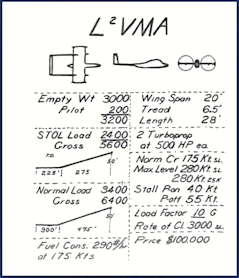
1. General. The development of new aircraft and associated weapons systems has been characterized by a mechanical approach to combat. Speed is the answer to defense and survivability problems; range is the answer to the vulnerability of the base; black boxes are being added for target acquisition. While this approach has produced many advances, it has limitations. The previously noted inadequacies can be attributed largely to an emphasis on performance as a substitute for tactics. Analysis of the close air support problem indicates that here, at least, is one issue that can be better solved by making the weapon implement the tactics, than forcing the tactics to support the weapon. SPECIFICATIONS AND DESIGN REQUIREMENTS 1. Operate with Supported Troops. The first design requirement considered was that the airplane be able to operate with the supported troops without the necessity of any fixed base installation. This would permit integration with the ground scheme of maneuver and provide the minimum passive defense against counter air operations in the combat area. Operations from within a regimental or battalion perimeter would also minimize the security problems that beset forward tactical airfields, especially where guerilla action on infiltration tactics are considered. The military definition of STOL (500' to a 50' obstacle) allows takeoff and landing in moist of the areas in which limited war might be fought. In addition, the airplane was designed to use roads so that operation would even be possible in jungle areas where clearings are few and far between. As a result the wingspan was limited to twenty feet and a heavy trailing arm type landing gear with a tread of 6.5ft was provided for operation from roads. Float operation is feasible.
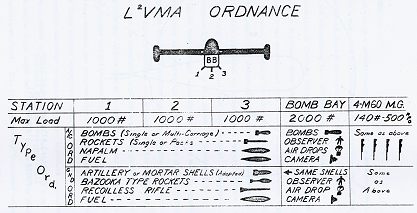
2. Minimum Logistics. Operations with the supported troops also demand that logistics be kept to a minimum. Therefore, the airplane is small having a gross weight of 5300lbs for STOL operation. Two turboprop engines of 500hp each using 7 ½' props and the principle of deflected slipstream can provide the necessary takeoff performance. Fuel consumption would not be excessive - about 50 gal/hr and the engines can be burned, i.e., MO-gas, kerosene, JP-5. Simple design and more particularly the elimination of "black boxes" should make maintenance easy. Very little support equipment should be needed since there is no component that cannot be lifted by hand. Provision for the use of infantry ordnance further simplifies the logistics problems. A small bomb bay and external racks can be used for carrying bazookas, recoilless rifles or 4.2 mortar shells, if they can be modified efficiently for aircraft use. The primary weapon would be multiple M-73 machine guns. This allows maximum flexibility. If logistics are critical and STOL operations necessary, infantry type ordnance would be carried and all necessary support provided by 6x6 truck or helicopter. On the other hand, if an air base or carrier were available, better than 2,000lbs of aviation type ordnance could be carried.
b. Guns. The most effective all around weapon will be the four 7.6mm machine guns (or similar type weapons)
which are effective against troops, unarmored vehicles and helicopters. Strafing is not limited by safe separation requirements and targets can be hit with precision without risking damage to nearby personnel or property. There would be no particular problem in mounting 20 mm guns, if necessary. However, unless developments like the German anti-tank 20 mm prove effective, the heavier guns would probably not be desirable. d. Miscellaneous Targets. For bunkers, roads and rail cuts and bridges, low level attack with delay fuse bombs seems to be the best approach. Napalm, a number of small bombs or possibly mortar shells or their equivalent could also be carried, if the situation so warranted. e. Sample Loads. While further evaluation of specific weapons is required, the aircraft will be able to carry a sufficient quantity of aviation or modified infantry type ordnance to provide an extremely flexible capability. The following loads would be feasible and give an indication of the possibilities of the aircraft: (1) Dispersed situation, operating with the infantry, where logistics are critical and aviation type ordnance is not available. (a) Four machine guns for troops, unarmored vehicles and helicopters. (2) From a short forward airfield with aviation ordnance:
SPECIFICATIONS AND DESIGN REQUIREMENTS CONTINUED 7. Armed Reconnaissance. Since an
armed reconnaissance capability is required and it is visualized that
many of the tasks performed by fixed wing VMO types could also be performed,
provision is made for two seats. The seat for the observer is located
in the bomb bay and can be removed when not in use. Visibility is o
prime importance in an aircraft of this type. Therefore, a configuration
with both seats in front of the wing was decided upon. The wing is set
approximately even with the pilot's shoulders providing 360 degree visibility
above the wing. Un obstructed visibility forward and back under the
wing for a considerable distance gives the pilot the best possible combination.
The observer is limited by the pilot in front of him and the wing behind
him, but he should be able to see almost straight ahead by looking around
the pilot's head and will be able to back under the wing about 30 degrees.
Side by side seating was rejected because it would limit visibility
for the pilot in the attack role. Increased frontal area would also
cause more drag and present a better target. TACTICS AND EMPLOYMENT 1. Organization. Now that the airplane has been described, general principals affecting tactics and employment will be covered in order that its effectiveness and survivability can be evaluated. An organization will have to be developed which is flexible enough to provide administration, maintenance and training in garrison and to permit either centralized or local control in combat. If the tactical situation permitted, a small airstrip with central logistics support would allow maximum efficiency and flexibility in accordance with the concept of centralized control. In a dispersed situation, where logistics, communications and passive defense were controlling factors, a small headquarters based at the nearest available sanctuary field could provide major maintenance and replacements for units operating with a regiment or battalion. For operations in the field, aircraft would probably be used in pairs. This would permit a choice of single plane operation with a back-up or section operation. It would also allow more efficient use of the limited support equipment required. (a) Helicopter Operations will require considerable attention in the future and the light attack type is ideally suited to this problem. Performance haracteristics are such that helicopter operations can either be supported or opposed with facility. The light attack is fast enough to catch helicopters or provide cover for them, but is not too fast to operate in the same general area. It also has the firepower and maneuverability necessary for rapid decisive action and attack. (b) Defense Against Fighters and Guided Missiles will be accomplished primarily by evading the radar that these weapons depend upon so heavily. Infrared shielding will provide additional protection. In the event that enemy fighters do make contact the addition of a pair of Sidewinders would leave the enemy with little advantage except initiative. SUMMARY 1. General. The tactics and aircraft design which resulted from this study embody many innovations and further development and testing will be required to perfect detailed aircraft specifications and tactical doctrine. The use of light aircraft does show considerable promise, however, and the major aspects of the concept can be evaluated by an application of the checks of suitability, feasibility and acceptability. These webpages were originally created in 2002 when K.P. was still involved with Volante Aircraft. He knew it all wouldn't last forever and agreed to let me post these OV-10 Bronco web pages on an alternate site for posterity. K.P. and his wife did manage to make it to the Chino Air Show to see the work Mike Manclark's OV10 Squadron is doing as they restore some OV-10 Broncos. 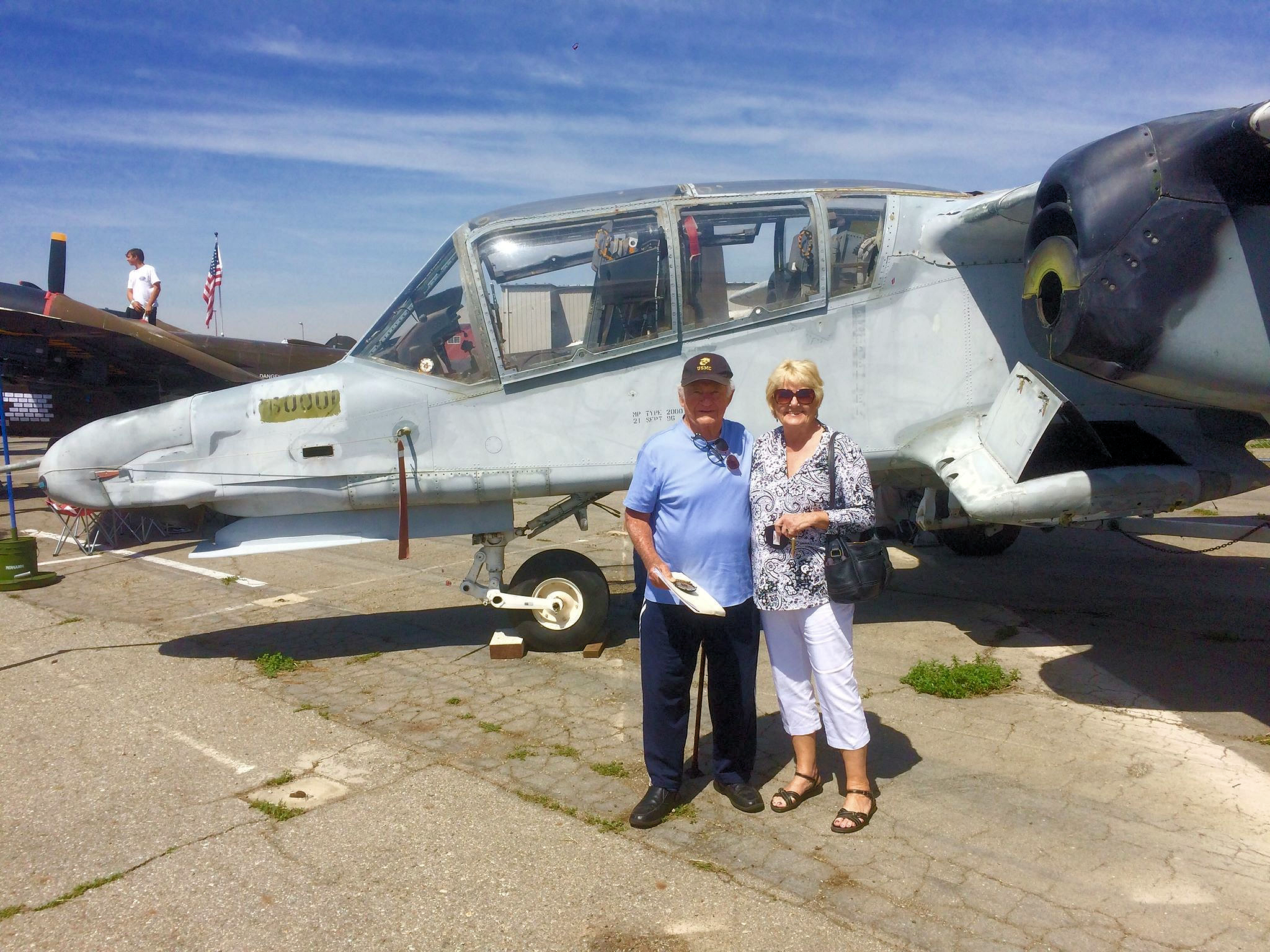 Page Created: Januaary 2026 |
|---|
 General suitable and Effectiveness. It is the inability to deal adequately with small, fleeting targets that accounts for most of the inadequacies in air support. The development of highly sophisticated electronic equipment for new attack aircraft like the A2F is one approach to the problem. When equipment like side looking and terrain clearance radar is perfected and used in conjunction with some of the newer guided weapons, it will provide a really formidable all-weather capability.
 3. Ordnance.